Filed under:
News
Date:
10-09-2026
Filed under:
News
Date:
10-09-2026
The amount of data generated in space is increasing much faster than our ability to bring it back to Earth. Very-high-resolution optical instruments, hyperspectral sensors, synthetic aperture radar and signals-intelligence payloads are producing increasingly large and complex data streams. Yet downlink capacity remains constrained by spectrum, available power, ground-station access and cost. Most Earth observation missions are already downlink-limited.
The next generation of sensors will widen that gap. The answer is not simply to put more computing power in orbit. It is to build space edge computers capable of continuously transforming high-volume raw data into smaller, more useful and more valuable products. This makes throughput the defining performance parameter for space edge computing, but throughput must be understood as more than the bandwidth of an interface.
What matters is value throughput: the sustained rate at which a platform can ingest raw data, refine it and produce an output with greater information density and greater value to the mission and its end users.
From data volume to value density
Raw sensor data is necessary, but it is rarely the product an end user actually needs. An Earth observation customer does not necessarily want every bit of data generated by the sensor. A maritime operator may want the position, classification and heading of a vessel. A defence user may need the coordinates and confidence level of a detected target. An autonomous spacecraft may need a decision input for its next action. Edge processing creates these products through several levels of refinement:
At each stage, data volume decreases while the density of mission-relevant information increases. A raw acquisition may contain gigabytes of sensor data. After onboard processing, its relevant content could be represented by a small annotated image, a thumbnail, a set of coordinates or a machine-readable alert. The output contains far fewer bits, but each bit carries more value.
This is the fundamental purpose of space edge computing: not merely to process data, but to increase its value density.
Throughput determines how much of the mission can be refined
Value density describes the improvement made to the data. Throughput describes how quickly and at what scale that improvement can be performed. A computer running an advanced algorithm on a small sample has demonstrated a capability. A computer that can apply it continuously to the full sensor stream can deliver an operational service. That distinction is critical.
If a sensor generates 20 gigabits per second but the processing pipeline can sustain only 2, most of the data must still be stored, discarded or downlinked for later processing. The algorithm may be impressive, but it has not solved the mission’s data problem.
The relevant performance question is therefore:
How much raw sensor data can the platform continuously transform into a smaller, more useful output?
Value throughput combines three aspects of that transformation:
A mathematical interpretation of this would be to scale a normalized version of the data throughput, T/T0, by both the compression ratio, 0<C<1, and information retentions ratio, 0<I<1, so that the value throughput, V, becomes V=TG, where G=I/(1-C) is mission-information density gain. For a pipeline with a raw throughput of T=20 Gbps, a normalization factor of T0=1 Gbps, and a lossy compression algorithm that achieves 95% compression at 95% information retention G=0.95/(1-0.95)=19 and V=20/1×19=380.
In practice value throughput cannot always be reduced to one universal number because value depends on the application. However, it provides a much better basis for evaluating a space edge computer than the peak specification of any individual processor.
A meaningful benchmark might state that a pipeline sustained a specified input rate, performed a defined series of refinement steps, reduced the output by a given factor and retained the information required for the mission task. That describes an operational capability. A TOPS figure alone does not.
Applications run through systems, not individual processors
Modern space edge computers contain increasingly capable components. CPUs, GPUs, FPGAs and AI accelerators can all provide impressive performance, but they are optimized for different parts of the workload.
An end-to-end sensor-processing service may require:
FPGAs are particularly effective for high-rate data streaming operations. CPUs provide flexibility and orchestration. GPUs accelerate image and signal processing. Dedicated AI accelerators deliver efficient inference. Storage is needed to buffer acquisitions, intermediate results and output products.
The performance of this heterogeneous architecture is not determined by its strongest component. It is determined by whether data can move efficiently through the complete chain.
A high-performance GPU cannot process data it does not receive. A large FPGA creates limited system value if its output is constrained by the next interface. An efficient AI accelerator will spend much of its time waiting if preprocessing cannot supply it with correctly formatted inputs. Fast processors provide limited benefit if storage cannot sustain the required reads and writes.
This is why comparing space edge computers only by TOPS, TFLOPS or FPGA resources can be misleading. These figures describe computational potential. They do not demonstrate that the complete system can turn a live sensor stream into a useful product at the required rate.
The integration challenge becomes the customer’s problem
Mission developers can assemble an edge-processing system from separate compute, interface, acceleration and storage products. In principle, all the required building blocks are available. But customers do not ultimately need a collection of components. They need working services.
Integrating the components transfers a substantial engineering challenge to the mission developer. Hardware interfaces must be designed and qualified. Drivers must be developed. Memory transfers must be optimized. Data formats must be aligned. Processing stages must be divided between resources. Storage and buffering must be dimensioned. Software must be made robust enough for reliable operation in space.
A system assembled from individually powerful components may still contain bottlenecks between every processing stage. Eliminating them requires detailed co-design of the hardware, data architecture and application software, only possible in a highly integrated system. This work takes time, introduces program risk and can prevent the system from approaching the performance suggested by its component datasheets. A space edge computer should therefore be evaluated not only by what components it contains, but by how much of their combined performance has been made available to real applications.
Refinement can unlock new communications options
Increasing value density can do more than reduce downlink cost. It can change how the information reaches the end user. Full-resolution imagery normally requires a high-capacity ground-station link. If no suitable station is available, the data must wait for the next contact.
Some spacecraft can also access more frequently available but much narrower bandwidth communication channels, including satellite communication services used for tasking and short messages. These links cannot carry raw imagery, but they may be able to transmit a compact insight.
A high-throughput onboard pipeline can process the complete acquisition and reduce it to a sub-megabyte product: for example, an annotated thumbnail accompanied by target coordinates, classification and confidence information. The result may then fit through a immediate communications channel that could never have carried the source data. The value is not created by faster communications. It is created by refining the data until every transmitted bit carries enough mission-relevant information to make the available link useful.
A complete hyperspectral-to-insight pipeline
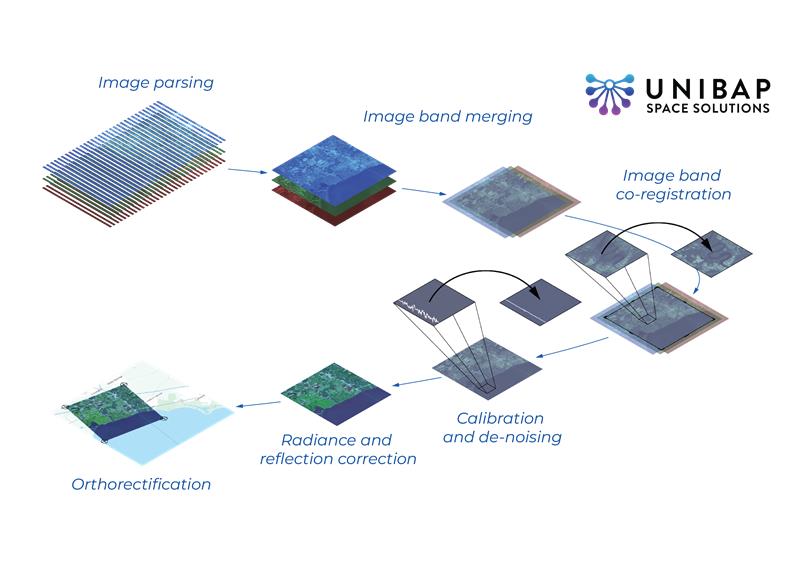
Consider a hyperspectral ISR application. Raw data enters the edge computer from the sensor and is passed into the processing pipeline. The image data must be parsed, AOCS metadata must be extracted, the spectral bands merged and co-registered, and the acquisition calibrated and denoised. Radiance and reflectance corrections are applied before the result is georeferenced.
The resulting image is then divided into suitable tiles and passed to object-identification models. Instead of downlinking the complete hyperspectral acquisition, the system can select detected ships, aircraft or other relevant objects and generate compact outputs containing thumbnails, classifications, coordinates, timestamps and confidence values.
Delivering this service requires more than an AI accelerator. The FPGA must ingest the sensor stream. The CPU must orchestrate the pipeline. The GPU must perform highly parallel image processing. Storage must sustain the required reads and writes. Dedicated AI acceleration must execute the detection models. Data must move between all these resources without becoming trapped behind copies or constrained interfaces.
The performance of the complete pipeline, not the peak performance of one component, determines whether the mission can process every acquisition or only selected samples.
iX20: Designed around the complete data journey
This system-level challenge has guided the design of Unibap’s next-generation edge computer iX20.
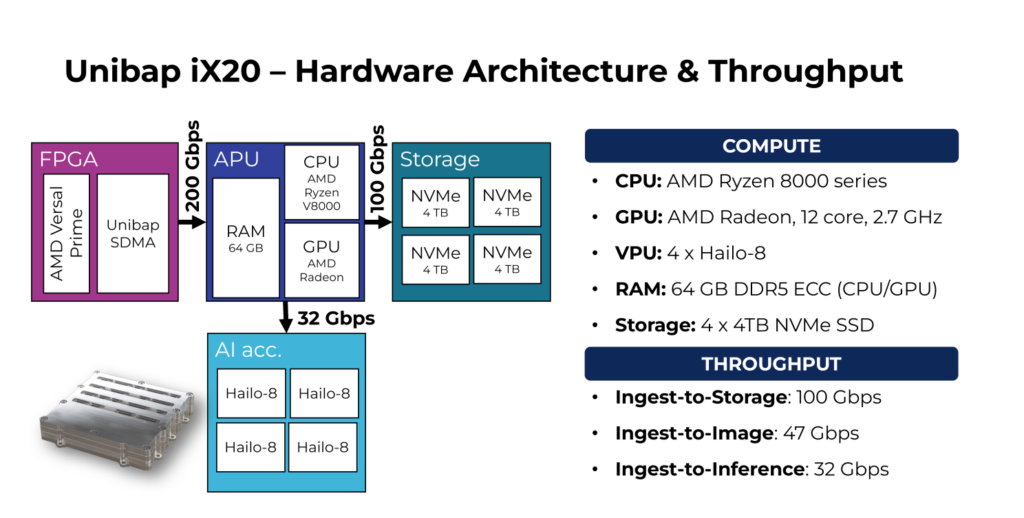
The platform brings together highly capable processing resources: an AMD Versal Prime FPGA, an AMD Ryzen 8000-series APU combining CPU and Radeon GPU resources, four Hailo-8 AI accelerators and high-speed NVMe storage.
The individual components are competitive in their own right. The Radeon 780M provides strong general-purpose FP32 performance, while the Hailo-8 accelerators provide highly power-efficient AI inference. The Versal Prime FPGA supplies the programmable logic and high-speed transceivers required for demanding sensor interfaces and streaming preprocessing.
The defining feature, however, is how these resources are integrated.
The iX20 can ingest up to 400 Gbps through its available high-speed interfaces. A PCIe Gen4 x8 connection provides up to 200 Gbps of interface bandwidth between the FPGA and the APU. The APU can transfer up to 100 Gbps to storage and up to 32 Gbps to the dedicated AI acceleration.
Unibap’s SDMA technology streams data from the FPGA directly into memory accessible through the APU’s IOMMU. The CPU and GPU can access the data without the additional memory copies that often become hidden bottlenecks in high-rate pipelines.
Ingestion, CPU and GPU processing, storage access and AI inference can operate concurrently. This allows iX20 to function as a continuous data-refinement pipeline rather than a collection of processors executing isolated tasks.
The hardware capability is complemented by Unibap LOOM, Unibap’s modular software pipeline for high-throughput sensor-data refinement. On iX20 hardware, Unibap LOOM has demonstrated 47 Gbps of sustained throughput in real-time hyperspectral image formation. The processing chain included data ingestion, image parsing, band merging and co-registration, calibration and denoising, radiance and reflectance correction, georeferencing, and the associated storage reads and writes.
This result demonstrates application throughput across a working refinement pipeline, and not merely the theoretical capacity of one component or interface.
Benchmark value creation, not specification sheets
As space sensors grow more capable, the limiting factor will increasingly be the ability to refine their output in orbit. The industry therefore needs to look beyond component-level comparisons. TOPS, TFLOPS, FPGA resources and interface speeds remain relevant, but they should be treated as inputs to system performance – not substitutes for it.
Mission designers should ask:
The most capable space edge computer is not necessarily the one with the largest number beside a single component.
It is the one that can continuously transform the largest flow of raw data into the densest concentration of useful information.
That is value throughput, the domain where iX20 is designed to excel.
Anders Persson , Head of Strategy & Products at Unibap Space Solutions