Filed under:
News
Date:
15-07-2026
Filed under:
News
Date:
15-07-2026
As Earth observation missions generate larger and more complex volumes of data, a central question is shaping the next generation of space infrastructure: how much intelligence can be moved closer to the source of the data?
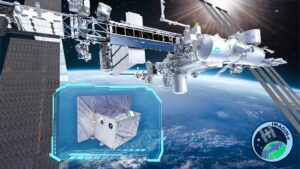
IMAGIN-e payload concept aboard the ISS. Image credit: © Thales Alenia Space
The IMAGIN-e mission set out to explore exactly that. Developed by Thales Alenia Space, the payload was launched to the International Space Station in March 2024 as an experimental platform to demonstrate space edge computing in a real orbital environment. Its purpose was ambitious: to validate how advanced onboard processing, cloud-inspired software frameworks and AI-enabled applications can change the way data is captured, processed and delivered from space.
For Unibap Space Solutions, IMAGIN-e represented an important collaboration with Thales Alenia Space and a strong demonstration of how reliable onboard computing can enable more autonomous, efficient and software-defined space missions.
Traditionally, Earth observation missions have relied heavily on downlinking large volumes of raw data to the ground for processing. This creates a bottleneck: bandwidth is limited, latency can be high, and important insights may arrive later than needed for time-sensitive applications such as environmental monitoring, maritime surveillance, disaster response or climate-related decision support.
IMAGIN-e challenged this model by bringing cloud-like computing capabilities into orbit. The payload combines visible and hyperspectral Earth observation sensors with onboard processing resources and an application framework that allows data to be analyzed directly in space. This approach supports faster insight generation, more selective downlink and greater autonomy for orbital systems.
“IMAGIN-e achieved the successful demonstration of space edge computing capabilities aboard the International Space Station, extending cloud computing capabilities on the ground with a cloud node in orbit capable of performing advanced data processing on sensor data by multiple applications simultaneously. This made it possible to analyze large sets of Earth observation imagery and other payload data in real time, dramatically reducing the need to downlink raw data to the ground. Additionally, the project marked a major milestone in leveraging commercial cloud and AI technologies for space applications, fostering collaboration among industry players and paving the way for a new era of space digitalization.”
This capability is more than a technical milestone. It points toward a new operational model for space systems: one where satellites and orbital platforms do not simply collect data, but interpret, prioritize and prepare it for use before transmission to Earth.
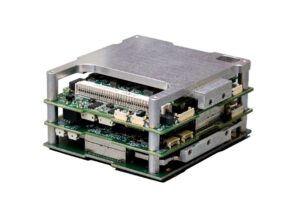
Within the IMAGIN-e architecture, Unibap Space Solutions contributed the onboard computer used to support key control and data-handling functions of the payload. The Unibap iX5 acted as a central element between sensors and processing units, supporting synchronization, routing, command and control, and selected image-pipeline functions.
In practical terms, this meant helping ensure that data could move reliably through the payload architecture, from sensor acquisition through initial processing and onward to higher-capacity processing resources. These are mission-critical functions in any orbital environment, where robustness, timing, power constraints and operational reliability all matter.
JULIÁN COBOS – Payload & Systems Product Manager at Thales Alenia Space in Spain:
“Unibap played a key role by providing the space-ready processing hardware used to run the control layers of the IMAGIN-e payload. Their OBC enabled us to reliably manage payload element command and control and supported flawless operation in the space environment, coordinating sensors and the high-capacity processing unit to bring advanced AI and data-processing capabilities onboard. Unibap’s technology was key to ensuring robust, real-time data processing under space environment constraints, and their collaborative approach facilitated integration and testing phases.”
Unibap’s iX5
For Unibap, the project was a strong validation of its focus on high-performance onboard computing for advanced space applications. The mission showed how the company’s technology can contribute not only to data processing, but also to the operational coordination required to make complex payloads work effectively in orbit.
Space missions are shaped not only by technology, but also by the quality of collaboration between partners. IMAGIN-e brought together capabilities across system integration, cloud software, sensor technology, onboard computing and application development. Delivering such a payload required clear ownership, disciplined communication and rapid decision-making, especially during integration and testing.
From Unibap’s perspective, the defining moments came when the project moved from design and planning into delivery, integration and verification. Those moments tested interfaces, requirements and decision paths – and reinforced the value of close collaboration between teams.
ADAM FARIS – Project Manager at Unibap Space Solutions:
“The defining moments came when deliveries and integration were put to the test. That was when we proved that close collaboration, clear ownership and fast decisions are critical to the successful development and delivery of a complex space product.“
That experience reinforced an important lesson for future missions: technical excellence alone is not enough. Complex space projects also depend on shared understanding, visible decisions and well-managed requirements.
ADAM FARIS – Project Manager at Unibap Space Solutions:
“One of the strongest lessons was the value of investing time upfront to communicate, understand and document customer requirements before a project begins. Technical ambiguity has a cost. Keeping requirements, open issues and decisions visible and jointly owned helps remove misunderstandings before they become problems. That discipline is something we now bring into every project.“
IMAGIN-e also helped demonstrate the value of opening space-based computing environments to a broader ecosystem of applications. Through initiatives such as the OrbitalAI challenge, developers and research teams explored how AI models could be prepared for Earth observation use cases including environmental monitoring, anomaly detection, land-cover analysis and maritime applications.
The mission has supported further experimentation in areas such as blockchain-backed data certification, autonomous in-orbit operations and onboard AI applications for remote sensing. Taken together, these demonstrations show how space edge computing can serve as a flexible testbed for multiple software-driven capabilities.
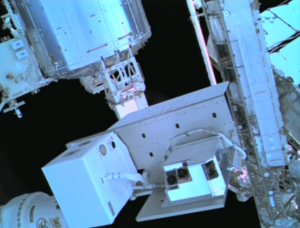
IMAGIN-e payload mounted on the ISS. Image credit: © Thales Alenia Space.
For Unibap and Thales Alenia Space, this collaboration fits into a wider industry direction: building more autonomous, intelligent and efficient space infrastructure. It also aligns with continued work in AI-driven Earth observation and cognitive cloud computing concepts, including follow-on initiatives such as 3CS4EO.
IMAGIN-e represents more than a single payload on the ISS. It is part of a broader shift in how the space sector thinks about data, computing and autonomy.
By proving that advanced processing can be performed closer to the data source, the mission helps reduce dependence on raw-data downlink, shorten the path from observation to insight and create new opportunities for software-defined services in orbit.
For Unibap Space Solutions, the project stands as a valuable collaboration with Thales Alenia Space and an important demonstration of the company’s role in enabling onboard intelligence. As future missions demand faster decisions, more efficient data handling and greater autonomy, the lessons from IMAGIN-e will continue to shape the next generation of intelligent space systems.