Filed under:
News
Date:
13-10-2026
Filed under:
News
Date:
13-10-2026
Unibap recently signed the first contract to supply edge computing platforms for satellites in a space-based signal intelligence mission. The customer is a European space defence company whose identity, together with that of the end user, remains confidential. The initial delivery covers only a handful of computers. Yet its strategic significance extends beyond the size of the order: it gives us a first foothold in an application that could become an important part of the next wave of space capabilities.
Our contribution starts with the satellites’ edge computing platform. The wider opportunity is the ability to analyse a much broader electromagnetic spectrum, containing information from many different sources simultaneously. To understand why that matters, it helps to consider how previous advances have changed our use of space.
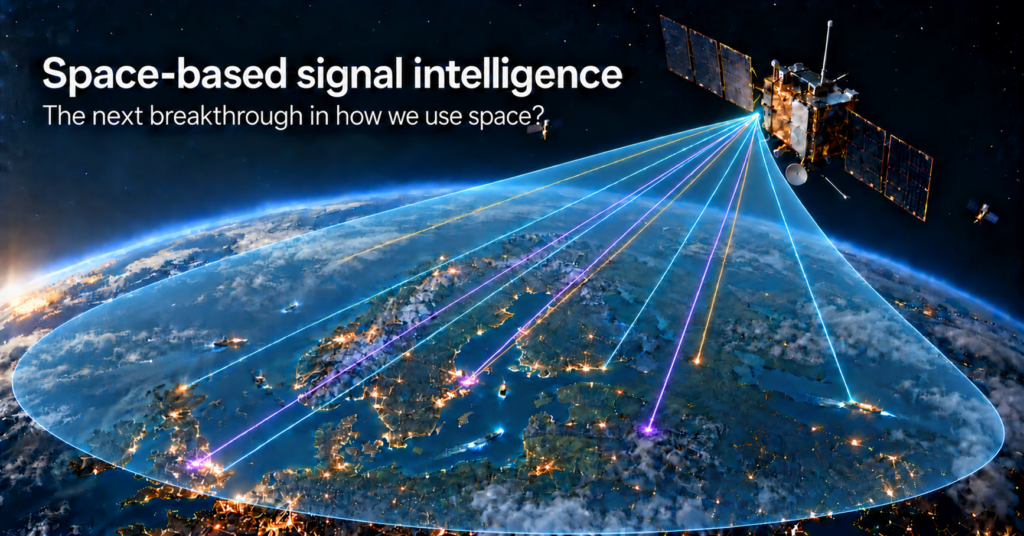
When technical capability becomes a new application
Satellite broadcasting and telecommunications became established during the 1960s and 1970s. Geostationary orbit provided an unusually powerful combination: a single satellite could serve a large region while remaining continuously visible from fixed ground antennas. Space offered a practical means of distributing information to many users over vast distances.
Satellite navigation followed a different path. GPS developed through the 1980s and reached full operational capability in 1995. A constellation of a few dozen satellites in medium Earth orbit made positioning and timing continuously available around the world. Its value came from precise measurements and dependable coverage, despite the comparatively small amount of data carried by the navigation signals.
Commercial high-resolution Earth observation gained momentum in the late 1990s, exemplified by the 1999 launch of IKONOS that eventually became today’s Maxar/Vantor. Here, the ability to generate detailed imagery opened new markets for information about the ground below. Resolution, collection capacity and revisit frequency shaped what the service could deliver.
More recently, Starlink’s deployment from the late 2010s and commercial expansion in the 2020s have demonstrated another step in scale. Thousands of satellites in low Earth orbit combine substantial communications capacity with overlapping coverage to sustain broadband connections as individual satellites pass overhead.
These developments do not follow a single performance metric. They do, however, share a pattern: advances in the amount of information a system can handle, or in how reliably it can serve an area, change which applications are practical. Affordability and deployment at scale then turn technical capability into widespread use.
We see a similar possibility for signal intelligence. High-throughput edge computing could expand the range and diversity of signals that satellites can analyse. Persistent observation presents a second, separate challenge.
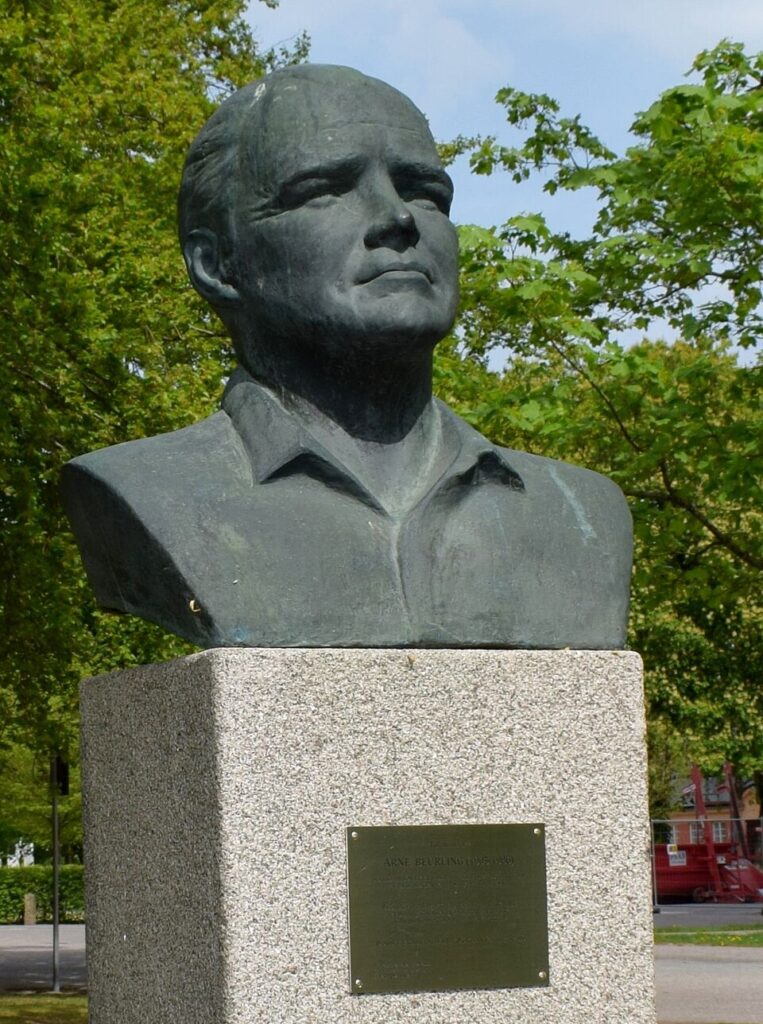
Arne Beurling who singlehandedly cracked the German G-code during WWII (Credit: Uppsala University)
A Swedish tradition, with roots in Uppsala
For a company based in Uppsala, signal intelligence has a particularly relevant historical connection. In 1940, Uppsala professor Arne Beurling reconstructed the workings of the German Geheimschreiber cipher from intercepted encrypted telegrams. His achievement enabled Sweden to read strategically important German communications during the Second World War.
Those messages travelled through telegraph cables. Later collection would increasingly involve signals transmitted through the air. Across both settings, the purpose remained to derive useful knowledge from an adversary’s communications and electronic activity.
The Cold War brought that work into sharp public focus in 1952, when a Swedish DC-3 carrying out a signals intelligence mission over the Baltic Sea was shot down by a Soviet fighter. All eight people aboard were lost. The incident remains a reminder of both the importance and the risks of intelligence collection.
Sweden’s airborne surveillance expertise has since developed into internationally recognised industrial capability. Saab’s GlobalEye combines radar, additional sensors and command-and-control functions in an airborne surveillance system. NATO’s selection of GlobalEye as its future AWACS capability illustrates the strength of that expertise. Although airborne early warning encompasses more than SIGINT, it provides relevant context for the sensor integration and onboard processing required to interpret a complex operational environment.
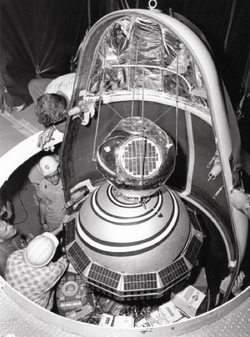
World’s first SIGINT satellite GRAB-1. (Credit: Wikipedia)
Signal intelligence has been in space for decades
Space-based SIGINT is an established capability. GRAB-1, launched in 1960, collected emissions from Soviet air-defence radars. JUMPSEAT, first launched in 1971, used highly elliptical orbits to provide extended observation of northern regions and collected several categories of signals, including communications and emissions associated with foreign weapons testing.
These programmes already demonstrated the importance of both collection capability and observation geometry. Space-based intelligence subsequently became a substantial governmental activity, much of whose capability remains outside public view.
A more recent change has been the emergence of commercial radio-frequency intelligence. HawkEye 360 launched its first three satellites in 2018 and began commercial RF geolocation in 2019, pioneering a market for satellite-derived RF analytics.
The opportunity ahead is to broaden the capabilities available to a wider range of operators. Detecting and locating selected emitters is valuable. Analysing a much broader spectrum, with many different sources present simultaneously, places substantially greater demands on the collection and processing system.
The throughput problem
The scale of that challenge becomes clearer when we compare the volumes handled by different missions. As indicative orders of magnitude, a Sentinel Earth observation satellite might deliver around 1.5 TB per day, while a high-resolution commercial imaging satellite in the Maxar/Vantor class might handle around 18 TB per day. Spread across 24 hours, these correspond to approximately 0.14 and 1.7 Gbps respectively. Actual volumes depend on the satellite, acquisition schedule and data product.
A Starlink V2 Mini satellite, by comparison, has communications capacity on the order of 100 Gbps – equivalent to approximately 45 TB per hour at full utilisation. Its mission is principally to transport communications traffic; that capacity does not represent scientific or intelligence analysis of the content.
Discussions with relevant stakeholders indicate that advanced airborne surveillance systems can handle internal sensor-data streams on the order of 400 Gbps. That corresponds to approximately 180 TB per operating hour. These figures describe different stages of different systems: EO data volumes, communications capacity and internal sensor-data throughput. They illustrate how much larger the data-handling requirement can become when a system must continuously examine a broad and complex signal environment.
For a satellite, preserving all those raw samples for later analysis can rapidly overwhelm storage and downlink resources. Onboard processing offers a way to examine the incoming stream and retain the signals, features and information relevant to the mission.
This is where Unibap’s iX20 illustrates a change in what satellite edge computing can make possible. With the capability to handle data streams of up to 100 Gbps for onboard analysis (approximately 45 TB per hour) it opens the door to advanced SIGINT applications that must examine a much broader spectrum and many different sources simultaneously. The achievable throughput depends on the processing workload, but the scale of the platform’s capability changes which applications can realistically be considered for deployment in space.
For us, this is the significance of high-throughput edge computing: enabling the satellite to extract mission-relevant information as signals arrive, before raw data volumes overwhelm storage and downlink resources. The useful performance measure is how much incoming data the complete platform can continuously transform into such information. That is the principle behind Unibap’s concept of #ValueThroughput, and it is particularly relevant when many signals must be analysed simultaneously.
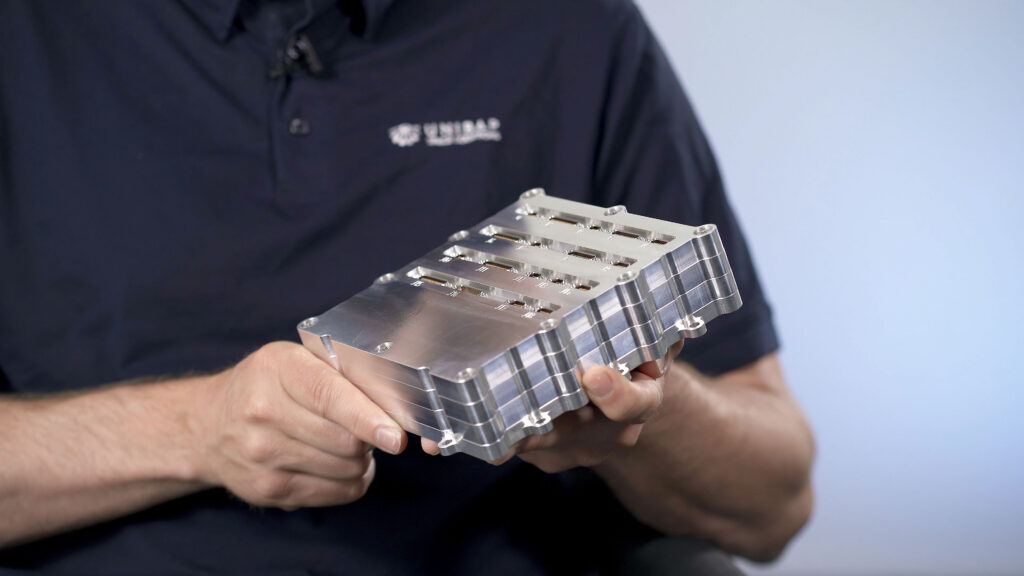
Unibap iX20 (Credit: Richard Öhrn)
The persistence problem
Even a satellite capable of analysing every signal within its field of view can only collect while it is in a suitable position. Processing capability cannot close a gap in observation. For SIGINT, those gaps matter. A brief transmission may begin and end between satellite passes. More frequent visits increase the opportunities to intercept it; continuous observation provides a different level of assurance. A constellation designed to detect occasional emissions therefore faces a different requirement from one intended to maintain awareness of activity throughout a particular area.
Broadening collection also introduces sensitivity challenges. Weaker signals may require larger or more capable antennas, more advanced receiver systems, or shorter distances between the emitter and satellite. Lower orbits can improve reception, but generally reduce the area visible to each satellite and shorten individual observation opportunities. Maintaining continuous coverage can consequently require more satellites and carefully coordinated observation geometry.
Throughput and persistence must therefore be developed together, while being treated as separate engineering challenges. The computing platform determines how much of the observed signal environment can be analysed. Sensors, orbital design and constellation architecture determine where and when that environment can be observed.
Persistence also has a direct industrial implication. For low-Earth-orbit systems, continuous observation across extensive areas requires constellations with enough satellites to maintain overlapping coverage as individual spacecraft pass overhead. Each additional satellite needs its own collection and processing capability. As operators extend the areas they monitor and increase continuity of coverage, demand can therefore grow from a small initial deployment into substantial volumes of satellites and edge computing platforms. Persistence is both an operational requirement and a structural driver of a potentially high-volume market.
A small first step into a larger opportunity
For European defence stakeholders, the prospect of analysing broader parts of the electromagnetic spectrum from space deserves serious attention. It could expand the information available for understanding activity across areas of strategic interest, while creating opportunities for European companies to develop and supply the necessary capabilities.
Our first contract in this field is modest in volume, but it could be a precursor to a much larger order as the mission develops. It allows Unibap to contribute to, and learn from, a new application of satellite edge computing while establishing a position in a market whose demand for persistent observation can drive deployment at scale.
Previous breakthroughs in society’s use of space emerged when technical advances made new services practical. We believe that the combination of high-throughput onboard processing and more persistent observation could enable a new leap for space-based signal intelligence. This first delivery gives us a first glimpse of that opportunity.
Anders Persson, Head of Strategy & Products at Unibap Space Solutions