Filed under:
News
Date:
19-10-2026
Filed under:
News
Date:
19-10-2026
Unibap is pleased to welcome Alex Wang as the U.S. Chief Revenue Officer.
Alex will lead our revenue growth strategy across priority markets and customers, supporting our continued growth in the U.S. and engagement with commercial, government, and defense space organizations.
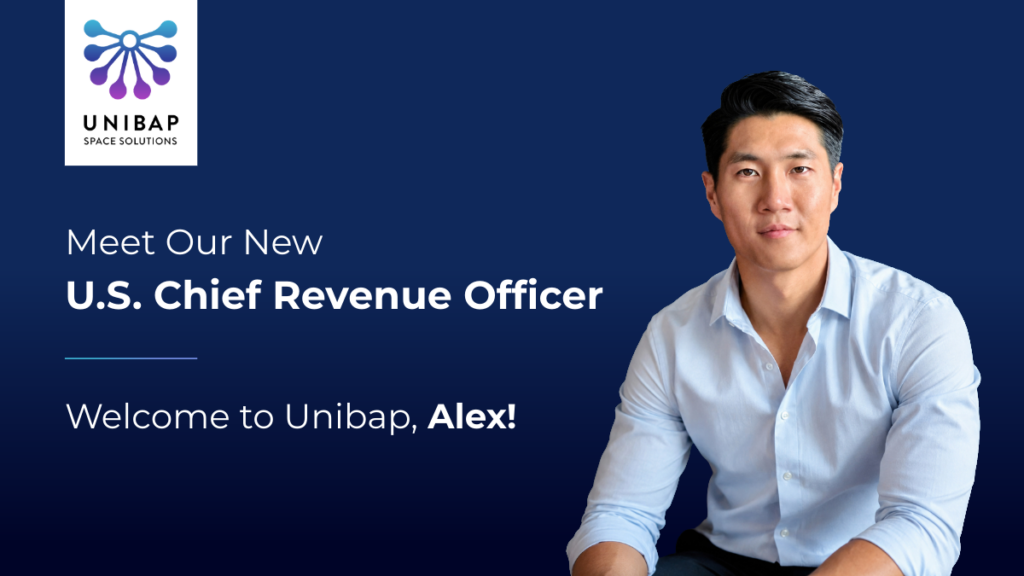
With a background spanning engineering, military operations, and commercial leadership, Alex has led growth efforts at SES Space & Defense, SpaceX, and Spire Global. He has supported mission partners across national security space, including the U.S. Space Force and National Reconnaissance Office. A U.S. Naval Academy graduate and former nuclear submarine officer, Alex brings a valuable perspective on connecting advanced technology with mission needs and commercial opportunities.
As Unibap continues to advance high-performance edge computing for space, Alex will play a key role in strengthening customer relationships, developing strategic partnerships, and accelerating the adoption of our solutions.
We asked Alex about the experiences that shaped him, what attracted him to Unibap, and what it will take to make onboard computing a foundation for future space missions.
Could you tell us a bit about yourself and your professional background?
“One of my earliest exposures to space exploration came from an unlikely place: the bottom of the ocean. During my time in the Navy, I supported a NASA Ames research effort where we used robotic deep-ocean exploration as an analog for exploring worlds beyond Earth. I’ve always been drawn to complex technology in demanding mission environments, beginning with my engineering studies focused on unmanned and autonomous underwater vehicles, and continuing into nuclear submarine service. Those early experiences shaped my desire to discover and apply emerging technology to consequential missions, particularly in space, and ultimately drew me into the new space industry.
Following active duty, I transitioned into commercial space and began working across solutions engineering and business development. I’ve worked on RF, EO, SAR, and AI-enabled satellite solutions, scoped payload and launch requirements, and developed mission concepts for the DoD and Intelligence Community. Over time, my responsibilities expanded across ISR, hosted payloads, and SATCOM architectures, spanning LEO, MEO, and GEO.
I’ve had the privilege of working across nearly every stage of bringing a new capability to market, from R&D and tech demos through product development and programs of record. I’ve also spent a significant part of my career building partnerships across the value chain, because complex space programs rarely succeed through the strength of one company alone.
Ultimately, I approach commercial leadership by connecting mission, people, and technology. Good business starts with listening: understanding the mission, valuing what matters to the people involved, and being deliberate about the problems we choose to solve. The work I find most compelling is getting to the heart of what a customer is trying to achieve and building the business case around a solution they genuinely value. The real commercial opportunity comes when that value supports healthy economics at scale. At Unibap U.S., I look forward to bringing those pieces together around opportunities where we can create meaningful impact and build a durable business. If we solve important problems well and earn trust along the way, growth will follow.”
What attracted you to Unibap and the opportunity to lead revenue growth for edge computing in space?
“Throughout my career, I’ve seen the value of a space system tied closely to how quickly it can convert information into action. Commercial operators and warfighters alike place a premium on high-fidelity intelligence delivered on short timelines. As modern spacecraft and sensors collect unprecedented volumes of data, the challenge is shifting from collection to efficient processing.
I’ve worked on that challenge firsthand in distributed sensing architectures, where multiple spacecraft collect complementary observations from different look angles, modalities, and spatial scales. Proliferation expands collection and resilience, but the real value comes from correlating those observations quickly. If each spacecraft must wait for ground contact or centralized processing before the information can be fused, latency becomes inherent to the architecture. For time-sensitive missions, that latency carries an economic cost.
Onboard computing creates an opportunity to shift portions of that workflow onto the edge, allowing distributed systems to process, correlate, and prioritize information closer to the point of collection. For ISR and multi-INT missions, edge processing can compress sensor-to-decision timelines while reducing unnecessary movement of raw data. In contested or degraded environments, where communications may be compromised, onboard compute can preserve mission utility, allowing spacecraft to adapt, reprioritize resources, and execute time-sensitive functions with greater autonomy.
The market is relatively young, and the industry is still defining where and how edge processing and AI should operate within space-based architectures. Yet the industry is already moving beyond individual compute requirements toward supervised autonomy, distributed sensing, and data orchestration. Demand for onboard intelligence is outpacing the maturity of the architectures and commercial models around it, leaving meaningful whitespace for Unibap to help define the market. I’m motivated by the opportunity not simply to compete for share in an established market, but to help shape one as it emerges.
Beyond its flight-proven technology, what stood out to me most was the business behind Unibap. The team brings together technical depth and strong business leadership in a grounded, collaborative culture. The company operates with discipline and capital efficiency, giving us a strong foundation to scale. I’m grateful to join this team and to have the opportunity to expand our footprint in the U.S. in support of consequential missions.”
How does your experience shape your view of the space market today?
“Customers ultimately do not buy technology in isolation; they invest in capabilities that deliver mission outcomes. Therefore, I evaluate emerging technology through a broader lens: a capability creates value only when it both solves a meaningful mission problem and offers a credible path to adoption. Working alongside DoD/IC and mission partners has shown me how difficult it can be to translate a promising demonstration into a capability that is fielded and effectively sustained. Superior technical performance can still lose its advantage when development or sustainment imposes disproportionate cost or schedule burden. Economics are part of the engineering problem.
The new space industry is learning to reconcile two cultures that historically operated very differently: commercial industry’s bias toward rapid iteration and national security’s requirement for mission assurance. I believe the companies that can bridge those two worlds will create disproportionate value. Successful teams plan for program transition alongside technical development. They understand the end user, acquisition path, and enduring demand from the outset, so development and transition reinforce one another.
Technology and threat environments are evolving too rapidly for innovation and acquisition to operate on separate timelines. As commercial systems become embedded in the national security architecture, the standard for commercial providers rises with them. Affordability, interoperability, and sustained mission assurance all become vital. I’m encouraged by the pace and depth of collaboration between government and industry. Adaptive acquisition strategies are allowing mission needs and commercial technologies to mature together.
For Unibap, that means meeting the mission-assurance standard without sacrificing the velocity and commercial discipline that make new space successful. Our value extends beyond demonstrating onboard computing capability; it lies in making edge processing economical to adopt, easier to integrate, and dependable in sustained operations. That is how a successful demonstration becomes an enduring capability, and ultimately how an emerging technology creates a scalable market.”
Where do you see the greatest commercial and defense opportunities for Unibap in the coming years?
“I see the greatest opportunities emerging from a broader shift in how onboard computing is designed into spacecraft. Today, spacecraft often use edge processors for relatively fixed functions, such as reducing latency and downlink demands for data-intensive Earth observation, ISR, or SSA missions. As edge computing matures, it can evolve from a single-application tool into a general-purpose infrastructure layer that supports the spacecraft throughout its operational life.
As constellations proliferate, the flexibility of a common computing platform enables individual spacecraft to operate in concert with greater autonomy. The mission value of distributed sensing lies in how effectively spacecraft can correlate data across their respective sensor modalities. One platform might detect an RF signal and tip-and-cue another platform to collect imagery over the same area. The architecture can fuse those data sets before they enter a centralized ground-processing chain or route selected workloads to higher-capacity processing nodes on orbit. As distributed architectures connect additional sensors and assets across orbital regimes, edge compute begins to shape how intelligence moves through the system. The result is a constellation that acts on information as an orchestrated system, with a common computing layer coordinating its assets, processing nodes, and workflows.
A computing layer also extends the useful operational life of a spacecraft. Spacecraft technology and mission requirements operate on very different timelines. A satellite may remain on orbit for years, while customer needs can evolve in a matter of months. A reprogrammable computing environment allows operators to update applications, reprioritize data flow, or introduce entirely new functions without redesigning the hardware. Much like a smartphone software update, the same hardware can gain new capability over time.
The commercial opportunity begins well before launch. Spacecraft manufacturers, payload providers, and constellation operators shape the architectural decisions that determine how onboard compute gets fielded. By engaging early in the design cycle, Unibap can establish a common computing environment across missions and spacecraft, reduce repeated integration work, and create a repeatable path to scale.
The future of onboard compute is as infrastructure rather than as a discrete subsystem. By providing a trusted computing foundation that customers and partners can build upon, Unibap creates value far beyond any individual compute unit. That foundation allows spacecraft to gain new capability after launch, enables greater supervised autonomy across distributed architectures, and supports a broader range of mission functions at the edge.”
We are excited to welcome Alex to our team and look forward to working together as we strengthen Unibap’s presence in the U.S. and help customers turn advanced onboard computing into dependable, scalable space capabilities.
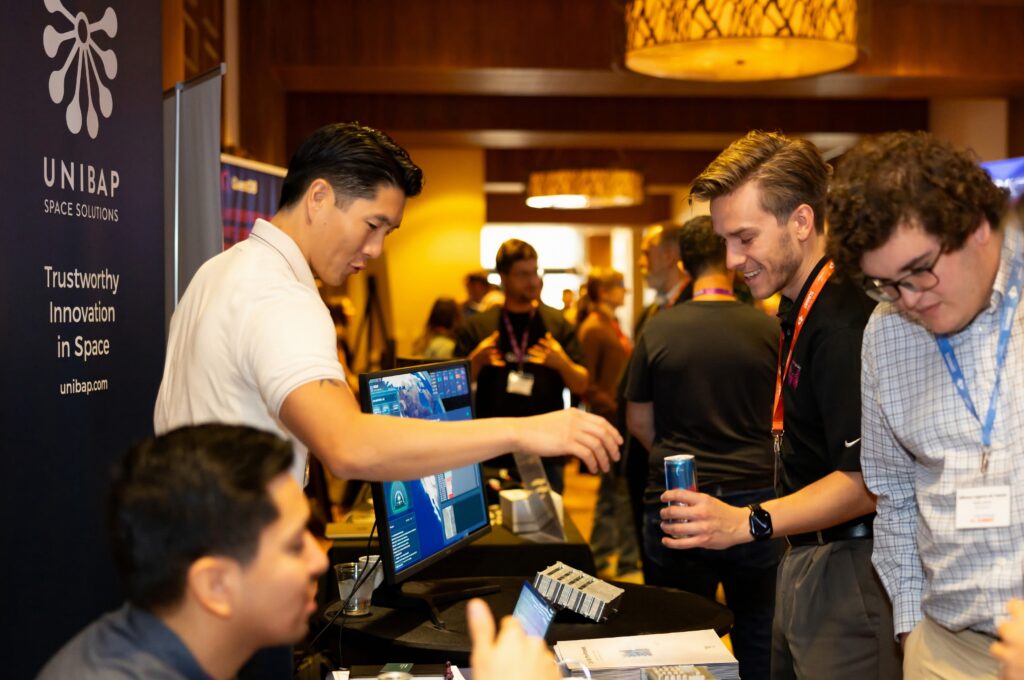
Alex representing Unibap at the Space Software Summit in Colorado, Oct 2026