Filed under:
News
Date:
12-10-2026
Filed under:
News
Date:
12-10-2026
Unibap is pleased to welcome Eduardo (Edy) Valdes as Managing Director, US.
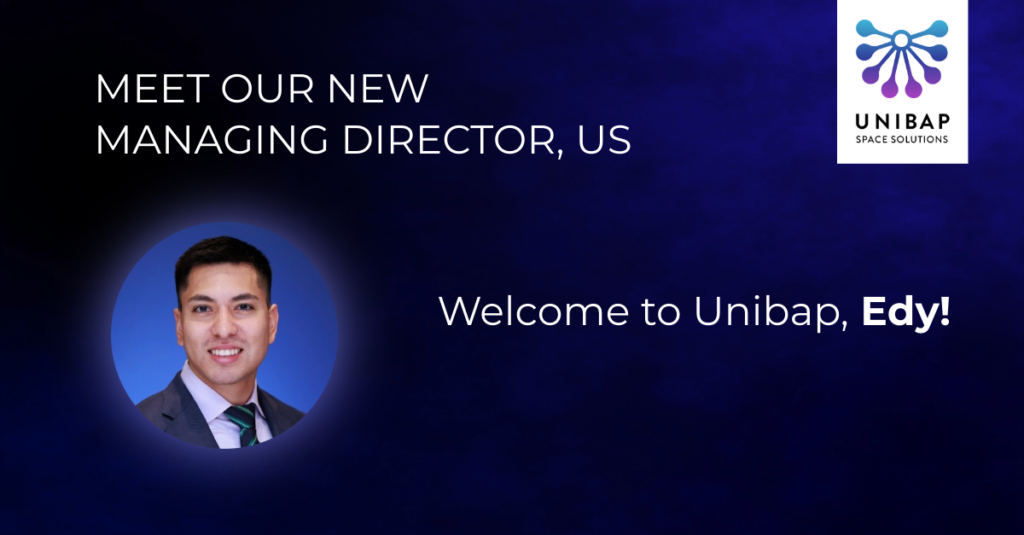
Edy joins Unibap at an important stage in our US growth, bringing a strong combination of engineering depth, space systems experience, commercial insight, and hands-on understanding of how advanced technologies move from concept to operational reality.
As Managing Director, US, Edy will oversee our US operations while supporting business development across commercial space, defense, and government markets. His experience across engineering, operations, satellite systems, and customer-facing strategy will help strengthen Unibap’s position as demand grows for onboard processing and edge computing in space.
We asked Edy to share more about his background, why he joined Unibap, and how he sees edge computing shaping the future of space.
What is your professional background, and what have been some of your most rewarding professional experiences?
“I’ve been fortunate to have a fast-paced career that has taken me across different technology stacks, value chains, and levels of assembly.
I started as a design engineer working on discrete devices, and over the following decade I worked through nearly every stage of the product lifecycle: research and development, plant commissioning, production processing, field testing, launch and operations, sustainment and sunsetting.
Some of the work I’m most proud of came early in my engineering career, when I developed a physical matrix topology that allowed a single reconfigurable device design to replace an entire catalogue. My work reduced manufacturing costs while significantly improving reliability.
I’ve also worked on new in-line testing methods and analytical models to increase production efficiency and product quality. Later, as I moved into other functional areas, I had the opportunity to lead incident response teams through mission-critical anomalies. Those experiences gave me a deep appreciation for reliability engineering and for the importance of designing systems that can perform under real operational pressure.”
What inspired you to join Unibap, and how do you think Unibap will play a role in the future of the space industry?
“As I moved through different parts of the space industry, I kept encountering the same problem: Time.
Whether the challenge was developing new technology, qualifying hardware, building control networks, commissioning vehicles, or acquiring data, much of the work was really about compression and acceleration. In a world where time is money, I started focusing on what could deliver the greatest impact with the most efficient effort.
That thinking led me to Unibap. I believe edge compute is one of the most effective ways for space companies to improve return on investment.
Many of the major trends we see today, including high-rate serialized platforms, high-speed optical communications, and wireless power transmission, are all connected to optimizing the time-value of information. Edge computing is powerful because it can create value today through near-term adoption and integration, while the industry continues to build out broader communications and power infrastructure in space.
Once those foundational layers become more widely available, the edge computing investments being made today will have even greater impact.”
How do you see your experience across aerospace engineering, satellite systems, and business development supporting Unibap’s growth in the US market?
“The space industry is a fascinating mix of technology development, geopolitical influence, and commercial dynamics. Because I’ve worked across different parts of that ecosystem, I’ve had the opportunity to see how these elements intersect.
I’ve been on the technical, commercial, and operational sides of different organizations, and I’ve worn different hats as a seller, buyer, and operator.
That has helped me understand the challenges engineers face when developing requirements, the challenges supply chain teams face when supporting new production models, and the challenges mission teams face when trying to maximize capacity and capability.
For Unibap, I think that perspective is valuable because successful growth depends on strong alignment with customers and partners. We need to understand the real problems they are solving and contribute meaningfully to those missions.
The US market is at an incredible inflection point. Commercial technologies are being adopted more rapidly by government customers through new acquisition frameworks, and capabilities that were once financially out of reach for many non-government users are becoming accessible to direct-space and space-adjacent companies.
Combined with the rapid development of AI-powered use cases, this is creating unprecedented momentum. I believe Unibap is very well positioned to support that growth.”
From your perspective, what will be most important for building a strong US presence for Unibap?
“To build a strong US presence, Unibap needs to leverage the foundations that have already made the company successful, while also building new high-performance teams and facilities.
Unibap has two differentiators that are difficult to develop: scale and expertise.
Supporting the growing US market means being able to deliver at scale and on time. That requires infrastructure scale, operational expertise, and a deep understanding of what it takes to reliably provide edge computing solutions to the market.
Unibap has grown organically and built strong mastery in this area. Our goal is to continue applying that recipe in the US, while adding the strengths of our growing team and operations.”
How do you see onboard processing and edge computing changing the way future space missions are designed and operated?
“One of the most significant changes will be the relationship between spacecraft and the people operating them.
When spacecraft can turn observations into useful information onboard, they can begin making selected decisions within boundaries set by their operators. An observation satellite could adjust its collection plan based on what it encounters. An inspection vehicle could adapt its approach to conditions that were difficult to anticipate from the ground.
That changes the way missions are designed. We need to decide where decision authority belongs, what context the spacecraft needs, and when it should ask for human input.
For mission teams, I expect more work to involve setting objectives, supervising behavior, and managing exceptions across multiple assets. Operators will still provide mission judgment and accountability, but spacecraft will take on more responsibility for execution.
This becomes especially important as higher production rates and broader commercial adoption put more spacecraft into service. The ability to manufacture at scale needs to be matched by the ability to operate at scale, without requiring a proportional increase in ground personnel and coordination.
That is where onboard computing can connect advances in production, infrastructure, and AI to a more sustainable operating model for increasingly capable space missions.”
We are excited to have Edy join Unibap as we continue strengthening our US presence and advancing edge computing for the next generation of space missions.
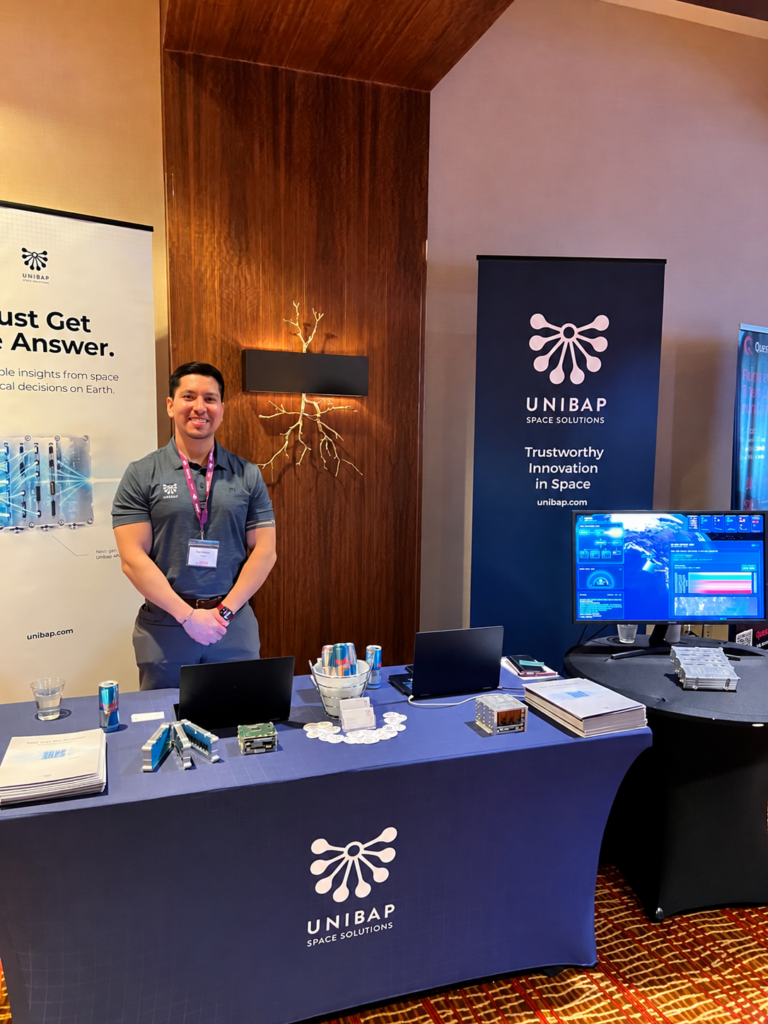
Edy representing Unibap at Space Software Summit, Oct 2026